



Contents
Table of Contents
Discover also...
Get a Head Start on the CSRD without stress or wasted time ! Our experts help you understand your obligations, organize your data, and ensure your compliance.
97% of clients of Mon Entreprise Durable say they have carried out their CSR projects without slowing down their business operations.
Introduction to the CSRD
The CSRD is a new European directive that is transforming the landscape of sustainability reporting. Although Switzerland is not a member of the European Union, this directive will have a significant impact on many Swiss companies. Whether you lead a large multinational corporation or a local SME, it is crucial to understand the implications of the CSRD for your business.
In this article, we will examine in detail the implications of the CSRD for Swiss companies and propose concrete steps to prepare for it. We will also discuss the regulatory changes planned in Switzerland, particularly the amendment to Article 964 of the Swiss Code of Obligations, which aims to align Swiss requirements with those of the EU.
What is the CSRD?
The CSRD, adopted by the European Union in December 2022, replaces the Non-Financial Reporting Directive (NFRD). The “Omnibus I” package, in effect since March 18, 2026, has since significantly narrowed its scope. Nevertheless, it represents a paradigm shift in the field of sustainability reporting, with implications far beyond the EU’s borders.
The main changes introduced by the CSRD are:
- An expansion of the scope of affected businesses (which has been significantly narrowed since the 2026 Omnibus Amendment)
- More detailed and standardized reporting requirements
- Introducing the concept of “double materiality
- An obligation to audit published information
The CSRD aims to improve the quality, consistency, and comparability of sustainability-related information disclosed by companies, a crucial aspect of corporate sustainability. It covers a wide range of topics, from greenhouse gas emissions to human rights and corporate governance.
Direct impact on Swiss companies
Although Switzerland is not a member of the EU, certain Swiss companies may be directly affected by the CSRD. Since the Omnibus Amendment took effect on March 18, 2026, the criteria for direct application to a non-European group have become more stringent than before:
- The company (or its group) generates more than 450 million euros in net revenue in the EU (compared with 150 million before the revision)
- It has at least one subsidiary or branch in the EU with revenue exceeding 200 million euros (compared with 40 million before the revision)
Let’s take the example of Nestlé, the Swiss food and beverage giant. The company, which generates a significant portion of its revenue in the EU and far exceeds these thresholds, remains directly subject to the CSRD. It must adapt its strategy and reporting to meet the new requirements, notably by establishing a sustainability committee at the board level and by increasing both the quantity and quality of ESG information published in its annual report.
Indirect impact on Swiss companies
The impact of the CSRD extends beyond the few hundred companies now directly affected. This ripple effect stems from the fact that large companies subject to the CSRD will pass on their obligations to their suppliers and business partners.
For Swiss SMEs, this means they may be required to provide detailed information about their environmental impact, social practices, and governance to their European customers, even if they are not themselves directly subject to the CSRD.
Imagine a small textile company in Lausanne supplying fabrics to a major French fashion brand. The latter, subject to the CSRD, is likely to request detailed information on the environmental impact, social practices and governance of its Swiss supplier. If the Lausanne-based company is unable to provide this information, it risks losing this important customer.
However, companies subject to the CSRD are granted a grace period before they are required to include their suppliers’ data in their reports, which gives SMEs some time to prepare—but it is still best to start preparing for these requirements now.
Challenges for Swiss companies
The CSRD presents several major challenges for Swiss companies:
- Access to the European market: More than half of Switzerland’s foreign trade is with the EU. To maintain this crucial access, affected Swiss companies will need to incorporate ESG standards into their strategies and ensure that they meet the requirements of the CSRD.
- New disclosure requirements: Companies will have to collect and analyze new dataThis may require significant investment in information systems and staff training.
- Adjustments to Corporate Governance: The directive introduces new corporate governance mechanisms. Affected Swiss companies may need to review their governance structure to ensure it meets the requirements of the CSRD.
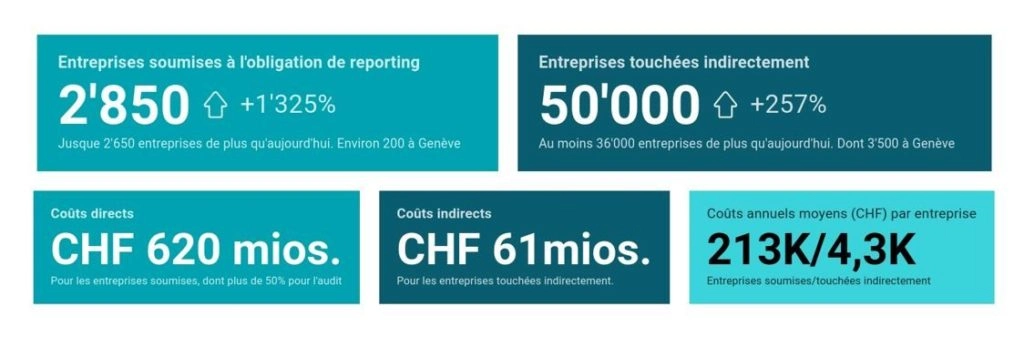
- Expected Costs: The 2026 Omnibus Revision has significantly reduced the number of companies directly subject to the regulations in both Switzerland and the EU—as a result, previous estimates of overall costs, which were calculated based on a much broader scope, are no longer representative. Each affected company must now estimate its own compliance costs.
- Need for new skills: Demand for professionals specializing in sustainability reporting remains strong in Switzerland, even though it involves a smaller number of companies than initially anticipated.
Benefits of CSRD Compliance
Despite the challenges it presents, compliance with the CSRD can offer several benefits to Swiss companies:
- Enhanced transparency and reputation : By publishing detailed information on their sustainable practices, companies boost the confidence of their stakeholders.
- Attracting ESG-conscious investors: More and more investors are taking ESG criteria into account in their investment decisions.
- Reducing sustainability-related financial risks: By analyzing their sustainability-related impacts and risks in depth, companies can anticipate and mitigate certain financial risks.
- Positioning as a leader in sustainability: Companies that anticipate these developments position themselves as leaders in their sector.
Take the example of Logitecha Swiss company specializing in computer peripherals. By anticipating the requirements of the CSRD, Logitech has been able to reinforce its position as sustainability leader in its sector. In particular, the company has implemented an ambitious program to reduce its CO2 emissions, and has considerably increased the transparency of its ESG reports.. The result? Enhanced reputation and appeal among responsible investors.
Non-compliance risks
Failure to comply with the CSRD can pose several risks to Swiss companies:
- Financial sanctions: Although Switzerland is not directly subject to EU sanctions, European subsidiaries or branches of Swiss companies could be.
- Reputational damage: In a world where sustainability is increasingly important to consumers, failure to comply with the CSRD could seriously tarnish a company’s image.
- Difficulties accessing financing: Many banks and investors now include ESG criteria in their financing decisions.
- Loss of competitiveness: Companies that fail to adapt quickly risk losing market share to competitors who are more proactive in terms of sustainability.
How can you prepare for the CSRD?
To prepare for the CSRD, Swiss companies can follow these key steps:
- Assess Your Situation: Determine whether your company is directly or indirectly affected by the CSRD.
- Carry out a dual materiality analysis: assess both the company’s impact on the environment and society, and the impact of sustainability issues on the company.
- Set up data collection systems: Ensure that you have the necessary tools to collect and analyze the data required by the CSRD.
- Training teams: Sustainability is not just one person’s business. It’s crucial to train employees in ESG issues and the importance of CSRD.
- Integrating Sustainability into Strategy: CSRD is not just about reporting. It must be integrated into the company’s overall strategy.
- Anticipate costs: According to estimates, the average cost of producing a report is around CHF 100,000, and of auditing it around CHF 113,000. Initial costs to prepare for the first year of reporting should also be taken into account.
Take the example of Givaudan, a world leader in flavors and fragrances based in Vernier. The company anticipated the requirements of the CSRD by implementing a comprehensive sustainability program called “A Sense of Tomorrow”. This program includes ambitious targets for CO2 emissions reduction, responsible sourcing and diversity. Givaudan has also invested in ESG data collection and analysis tools, enabling it to produce detailed reports in line with CSRD requirements.
Swiss Perspective: The Future Law on Sustainable Business Management
On April 1, 2026, the Swiss Federal Council launched a public consultation on a new draft federal law on sustainable corporate governance, which incorporates and replaces the initially proposed amendment to Article 964 of the Swiss Code of Obligations (CO). This consultation concluded on July 9, 2026; the Federal Council must submit its message and the final draft bill to Parliament no later than November 27, 2026—the text has therefore not yet been adopted.
This new proposal largely aligns Swiss requirements with the CSRD as amended by the European Omnibus Directive. The proposed thresholds are now:
- More than 1,000 full-time employees
- More than 450 million francs in annual revenue
With these significantly raised thresholds, it is estimated that only about 100 large Swiss companies would be directly subject to the reporting requirement—compared with nearly 3,000 companies covered in the previous version of the bill (2024). Once the law is adopted, a transitional period of approximately two years is planned before it takes effect, with the first concrete implementation not expected to occur before 2028–2029.
Let’s take the example of Migros, Switzerland’s largest retailer. Whether or not the final law directly applies to it, Migros has chosen to voluntarily align its reporting practices with international standards, including the CSRD. The company publishes annually a detailed sustainability report, covering aspects such as reducing CO2 emissions, sustainable sourcing, and working conditions in its supply chain—a move that Swiss SMEs supplying large corporations would be well advised to anticipate, regardless of the final scope of the legislation.
To conclude...
The CSRD represents a major shift in the sustainability reporting landscape, with significant implications for Switzerland’s largest companies and indirect repercussions for many SMEs through their business relationships. Although the legal scope has narrowed significantly since the initial announcements, compliance—whether mandatory or voluntary—with the CSRD offers opportunities in terms of transparency, investor appeal, and market positioning.
It remains important for Swiss companies—even those outside the direct scope—to anticipate these developments and begin preparing for them. This involves not only implementing the necessary reporting systems but also truly integrating sustainability into the company’s strategy and operations.
The new federal law on sustainable business management, which is currently under public review, is not expected to take effect until 2028–2029. This gives companies time to prepare, but it is still important not to underestimate the scope of the work that will need to be done when the time comes.
Here is a summary table by type of business:
| Type of company | Impact of CSRD | Actions to be taken |
|---|---|---|
| Large companies (>, 1,000 employees; >, 450 million CHF/EUR in revenue) | Direct impact (likely; Swiss law still in draft form) | Prepare a comprehensive report, set up data collection systems, and train teams |
| Non-European groups with EU revenue exceeding €450 million and an EU subsidiary >: €200 million | Direct impact (CSRD, already in effect) | Prepare a comprehensive report now and seek guidance from CSRD experts |
| SMEs that are suppliers to companies subject to the CSRD | Indirect impact | Prepare to provide ESG data to their clients; begin collecting relevant data |
| Other SMEs | Potential Future/Voluntary Impact | Monitor changes in Swiss law; consider implementing a voluntary CSR approach to remain competitive |
Not sure where to start when get started with your CSR efforts ? Take action and develop your action plan with our experts