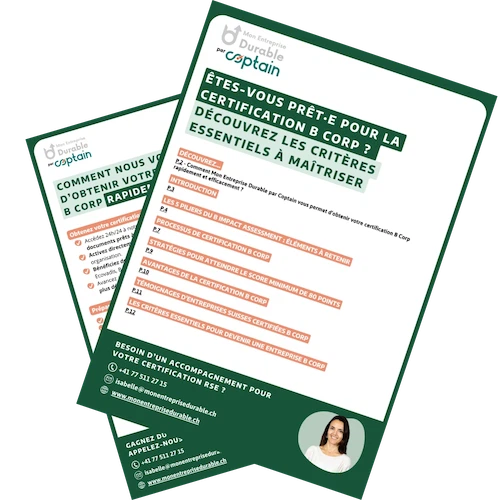


Table of Contents
Table of Contents
See also...
Becoming a B Corp without wasting months on red tape ! Our certified B Leader expert will guide you to make the process clear, fast, and tailored to your business.
97% of clients of Mon Entreprise Durable say they have carried out their CSR projects without slowing down their business operations.
Introduction
B Corp certification has become an essential tool for companies seeking to combine economic performance with a positive impact. This rigorous certification, issued by the nonprofit organization B Lab, attests that a company meets high standards in social and environmental performance, transparency, and legal accountability. Worldwide, more than 8,500 companies have earned this certification, including more than 130 in Switzerland, thereby demonstrating their commitment to a more inclusive and sustainable economy.
For businesses, regardless of their size or age, B Corp certification is much more than just a label. It provides a structured framework for embedding sustainability at the core of their business model—find out why you should choose the B Corp label for your organization. In a business ecosystem that is increasingly aware of social and environmental issues, this certification is becoming a powerful driver of growth and differentiation.
The 5 pillars of B Impact Assessment: key points to remember
As of April 2025, B Corp certification is no longer based on a points system through the B Impact Assessment (BIA), but rather on meeting mandatory criteria across seven impact areas. Here’s how companies can excel in each of these areas:
Governance and Purpose
Establishing responsible governance begins with formally incorporating the impact mission into the company’s articles of incorporation. This process, which is mandatory for obtaining B Corp certification, involves amending the legal documents to include a commitment to consider the impact on all stakeholders, not just shareholders. Companies can also establish governance structures tailored to their size, such as a board of directors or an advisory committee that includes sustainability experts.
Climate Action
Companies must demonstrate a specific and measurable plan to limit global warming to 1.5°C, ideally validated by a recognized scientific methodology such as the Science Based Targets Initiative (SBTi). This involves measuring their carbon footprint, setting quantified reduction targets, and regularly monitoring progress.
Human Rights
Companies must conduct regular, documented assessments of their potential and actual impacts on human rights, including throughout their supply chain. This involves identifying risks (forced labor, working conditions at suppliers, etc.) and implementing preventive and remedial measures.
Fair Labor
Companies can implement innovative practices to promote employee well-being and engagement, such as flexible work schedules, leave policies that go beyond legal requirements, training programs, competitive benefits, and health promotion initiatives.
For example, Patagonia, a B Corp-certified company, has adopted an “ outdoor culture ” with flexible time off on nice days, allowing its employees to enjoy the outdoors.
Justice, Equity, Diversity, and Inclusion (JEDI)
Companies must implement an explicit and proactive policy on inclusion, diversity, and equity at all levels of the organization: recruitment, compensation, and access to leadership positions. The goal is to document these commitments and measure progress over time, rather than merely stating intentions.
Environment and Circularity
Integrating environmental sustainability into the business model requires a drastic reduction in waste and greater resource circularity: energy savings, mobility, waste management, etc. The company SmartHelio exemplifies this approach: specializing in data analysis to optimize solar installations, it achieved an impressive score of 116.8 points during its B Corp certification (under the old scoring system) by developing artificial intelligence technology to improve the performance and predictive maintenance of solar installations.
Public Affairs and Collective Action
Companies must demonstrate active participation in collaborative initiatives that promote broader societal and environmental change. This can take the form of local initiatives, donations to organizations, or volunteering during work hours. For example, KAMPOS, a B Corp-certified company, is committed to protecting marine life and reducing plastic waste in the oceans, while raising awareness about overfishing and marine pollution.
B Corp Certification Process
The B Corp certification process is designed to be accessible to organizations of all sizes. Here are the key steps:
- Complete the B Impact Assessment (BIA): this free online self-assessment is the starting point of the process. It enables companies to assess their current impact and identify areas for improvement. This tool will provide you with a detailed analysis of your current performance and specific recommendations for improving your score in each area assessed.
- Attain a minimum score of 80 points: this is the threshold required to be eligible for certification.
- Verification and documentation: B Lab examines answers in detail and requests documentary evidence for around 6 to 10 selected questions.
- Amendment of articles of association: companies must formally incorporate their commitment to all stakeholders in their articles of association filed with the Commercial Registry. For more information on the specific legal requirements and phrases to be included depending on the company’s location, please consult the dedicated page on the B Lab website
- Transparency: Certified companies must make their B Corp Impact Report public.
In terms of costs, certification fees vary according to the company’s annual sales.
- For companies with annual sales of up to €2.5 million, the fee is €2,000 per year.
- For those with sales between €2.5 and €5 million, the annual fee is €2,500.
- These costs increase progressively with sales, reaching €50,000 for companies with annual sales between €750 million and €1 billion.
- For companies with sales in excess of €1 billion, special rates apply.
It is important to note that these charges are in euros, as invoices are sent from B Lab’s European headquarters in Amsterdam.
Strategies to reach the minimum score of 80 points
Meeting the mandatory criteria across the seven impact areas may seem like a challenge. Here are some effective strategies:
Prioritize high-impact actions: Focus on the areas where your company can have the greatest positive impact. To identify these priorities, start with an initial self-assessment based on the new B Corp criteria, which will provide you with an analysis of your current performance and specific recommendations by area.
Document your existing practices: Companies often already have sustainable practices in place but have not formally documented them. Document these practices to meet B Lab’s evidence requirements.
Get involved in the local community: take part in local initiatives or collaborate with other companies on impact projects.
Adopt written policies: put in place formal policies on topics such as diversity, inclusion, or sustainable procurement.
Measure and track your impact: Set up systems to measure your energy consumption, waste generation, social impact, or carbon emissions. Measurement is the first step toward improvement—and an explicit requirement of the Climate Action track.
Benefits of B Corp Certification
B Corp certification offers many benefits to companies:
Access to sustainable financing: As impact investing gains prominence, B Corp certification can open doors to investors focused on sustainability.
Market Differentiation: In a competitive business landscape, B Corp certification enables companies to stand out to consumers and business partners who are increasingly attuned to sustainability issues.
Attracting and Retaining Talent: In a tight labor market, B Corp certification can be a major asset in attracting talent that seeks to align their values with their job.
Greater resilience: B Corp-certified companies have demonstrated greater resilience in the face of economic crises. For example, they were 63% more likely to survive the 2008 recession than non-certified companies.
Integration into a committed community: Certification provides access to a network of more than 8,500 B Corps worldwide, offering opportunities for collaboration and mutual learning.
Testimonials from Swiss B Corp-Certified Companies
Several companies have already successfully obtained B Corp certification. Here are a few inspiring examples:
PLANTED
This food tech startup, which specializes in plant-based meat alternatives, has earned B Corp certification with an impressive score. Their commitment to sustainability is at the heart of their business model, from production to packaging.
JM Beaud
This small Swiss business specializing in automatic irrigation achieved a remarkable score during its B Corp certification. Their sustainable approach to a traditional business demonstrates that even small companies in conventional sectors can excel in the B Corp certification process by integrating sustainability into every stage of their operations.
These success stories demonstrate that companies of all sizes and across all industries can excel in the B Corp certification process by making their positive impact a central part of their strategy.
Conclusion: The Essential Criteria for Becoming a B Corp
- Responsible governance that formally integrates positive impact into the company’s articles of association.
- A strong commitment to employee well-being and development.
- A strong community base with concrete local impact initiatives.
- Integrating environmental sustainability into our business model.
- The development of products or services that create a measurable positive impact for customers and society.
- Attainment of a minimum score of 80 points in the B Impact Assessment, demonstrating overall commitment to these criteria.
By embarking on the B Corp certification process, you’re not just making a choice for your business—you’re actively helping to build a more inclusive and sustainable economy for the future.
Not sure where to start when get started with your CSR efforts ? Take action and develop your action plan with our experts