

Contents
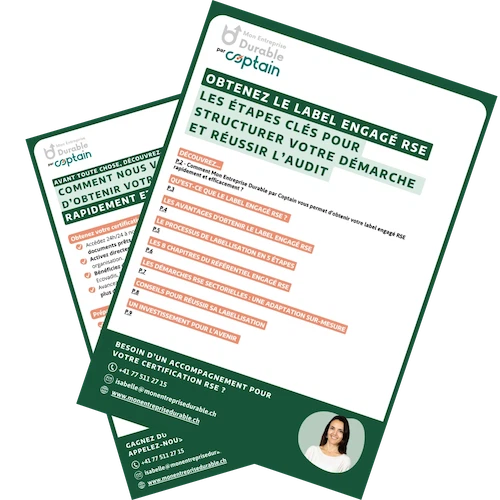
Table of Contents
Discover also...
Browse our “labels” ” certifications ” to learn everything there is to know about EcoVadis, B Corp, EcoEntreprise, etc.
And if you need help, we help dozens of companies every year to achieve certification.
In a world where Corporate Social Responsibility (CSR) is becoming a major issue, the Engagé RSE certification is establishing itself as an essential benchmark. Whether you’re an ambitious small or medium-sized business or a large corporation concerned about its impact, this guide will walk you through the process step by step to help you earn this valuable certification.
What is the Engagé RSE certification?
The Engagé RSE certification, issued by AFNOR Certification, is the French benchmark for assessing the maturity of organizations’ CSR initiatives. Based on the international standard ISO 26000, it is distinguished by its holistic approach and methodological rigor.
- The label offers four levels of maturity: Initial, Progression, Confirmed and Exemplary.
- Each level corresponds to an overall score out of 1000 points, with specific thresholds for each chapter of the reference system.
- The label is aimed at all types of organization, whatever their size or sector of activity.
- More than 220 organizations in France and abroad.
The Benefits of Earning the "Engagé RSE" Certification
Earning the “Engagé RSE” certification is not just a simple administrative formality. It’s a real strategic asset for your company. Here’s why:
- Access to preferential financing: Some banks offer preferential interest rates to companies with the “Engagé RSE” certification.
- Facilitating extra-financial reporting: The label considerably simplifies the production of the Extra-Financial Performance Declaration (EFPD), mandatory for large companies.
- Detailed sector benchmark: Labeled companies receive an anonymized benchmark report, enabling them to position themselves precisely in relation to their peers.
- A network for exchanging best practices: AFNOR regularly organizes “CSR clubs” reserved for certified companies, to encourage the sharing of experience.
- Added value in extra-financial ratings: The label is recognized by the main extra-financial rating agencies, potentially improving the company’s ESG score.
The 5-stage certification process
Obtaining the “Engagé RSE” certification requires careful preparation. Here are the key steps to follow:
- Initial self-assessment: Use the AFAQ 26000 online tool for an initial assessment. It allows you to simulate a score out of 1000 points.
- Preparing the project: Set up a cross-functional project team. On average, companies spend 6 to 12 months on this phase.
- On-site assessment: An independent, ICA-certified assessor conducts the assessment. He uses the PDCA (Plan-Do-Check-Act) method for each criterion. Interviews are conducted with a representative panel of stakeholders.
- Certification committee: A committee of independent experts examines the evaluation report and may request additional information before making a decision.
- Post-labeling follow-up: An 18-month follow-up audit verifies implementation of the progress plan. This is a crucial stage, often underestimated.
The 8 chapters of the Engagé RSE Framework
The Engagé RSE certification is based on a comprehensive set of standards consisting of 8 chapters and 55 evaluation criteria. Here is a detailed overview of these chapters:
- Vision and Governance: This chapter assesses the organization’s reflection on its values, vision, and purpose. It examines how CSR is integrated into the organization’s overall strategy and governance.
- Implementation of the Approach: This section analyzes how CSR is implemented within the company. It assesses the resources allocated, employee training, and the integration of CSR into decision-making processes.
- Human resources and human rights: This chapter examines practices in terms of human resources management, professional equality, diversity and respect for fundamental rights. It also assesses working conditions and social dialogue.
- Sustainable production and consumption: This section analyzes the environmental impact of the company’s activities, particularly in terms of eco-design, waste management and the circular economy.
- Territorial anchoring: This chapter assesses the company’s involvement in its local ecosystem, its relations with local authorities and its impact on the region’s economic and social development.
- Environment: This section looks in detail at actions to protect the environment, including energy and water management, biodiversity preservation and the fight against climate change.
- Business ethics: This chapter assesses practices in the areas of governance, business ethics, anti-corruption and compliance with competition rules.
- Products, Services, and Customer Relations: This section analyzes how CSR is incorporated into the company’s offerings, the quality of customer relations, and the information provided to consumers regarding the social and environmental impacts of products and services.
Sector-Specific CSR Initiatives: A Tailored Approach
AFNOR Certification has developed an innovative approach to adapt the “Engagé RSE” label to the specific characteristics of different industries. This initiative aims to accelerate the adoption of CSR by companies within their respective industries. In practical terms, this means:
- 10 sector-specific CSR labels created in collaboration with industry associations
- 6 Reading Guides on the “Engagé RSE” Label for Specific Sectors
- Sector-specific approaches, such as the CSR programme for waste management companies or the CSR rating system for the travel industry
These adjustments enable companies to meet the expectations of their stakeholders, strengthen their resilience, and gain access to new markets, while maintaining the methodological rigor of the original Engagé RSE label.
Tips for successful labeling
To maximize your chances of earning the “Engagé RSE” CSR certification, here are some practical tips:
- Involve management: Management’s commitment is crucial. At Roche Diagnostics France, which has been awarded the “Engagé RSE” certification at the exemplary level, this strong commitment has been a key factor in its success.
- Engage your teams: CSR is everyone’s responsibility. Train and raise awareness among all your employees. CELESTE, certified as “Engagé RSE” at the advanced level, has appointed CSR liaisons recognized for their ability to inform and bring people together.
- Structure your approach: Develop a CSR action plan with clear objectives and measurable indicators. That’s what CELESTE did, and it was praised by the evaluators.
- Document your actions: Keep a record of all your CSR initiatives, even the smallest ones. They will be invaluable during the evaluation.
- Dialogue with your stakeholders: The label places great importance on listening to and involving your stakeholders. Roche Diagnostics France has involved more than 50 internal and external stakeholders during its assessment.
- Think continuous improvement: The label is not an end in itself. Use the evaluators’ feedback to make constant progress. Rector Lesagethe 1st concrete manufacturer to receive the label, has drawn up commitments for 2025 and 2030 to pursue its efforts.
- Get some help: Don’t hesitate to seek assistance from CSR experts to guide you through the process. Many companies choose to do this to maximize their chances of success.
An investment in the future
Earning the “Engagé RSE” certification is a challenging—yet incredibly rewarding—programme. It’s an opportunity to structure your CSR approach, rally your teams around a unifying project, and set yourself apart in your market.
As Nicolas Aubé, founder and president of CELESTE: “This recognition validates our consistent CSR strategy and allows us to measure the performance of our efforts.” It is an investment in the future that will enable you to build a more resilient, attractive, and successful company over the long term.
So, are you ready to take on the challenge and join the ranks of Engagés RSE? The road ahead may seem long, but every step counts. And don’t forget: when it comes to CSR, what matters most isn’t the destination, but the journey and the progress made along the way.
Not sure where to start when get started with your CSR efforts ? Take action and develop your action plan with our experts