

Download 5 practical tools to manage your teams' mobility
Reduce your organization’s carbon footprint by taking action on commuting and business travel.
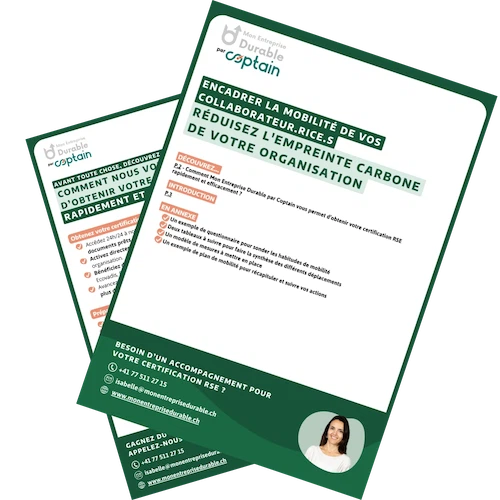
Employee mobility is a significant source of emissions for many companies. It is also a practical way to improve your CSR performance, meet the expectations of talent, and strengthen your local presence. This guide offers five essential and immediately actionable tools to help you structure your approach and engage your teams. You will receive:
- A sample questionnaire to survey your employees' commuting habits
- Two sample summary tables for quantifying trips
- A Sample Mobility Action Plan
- A table of typical metrics tailored to different employee profiles
By clicking “Download the guide,” you agree to have your information used to contact you in connection with our support services. Your information will remain strictly confidential and will never be shared with third parties. Learn more about our privacy policy.
How can this document help you ?

Make an accurate diagnosis
Using the provided questionnaire and summary tables, you can identify current travel patterns, distances traveled, bottlenecks, and the profiles with the highest carbon footprints. This provides you with an objective and structured foundation for your work.
Develop a realistic and phased action plan
The mobility plan guides you in organizing your initiatives along several lines: financial incentives, awareness campaigns, equipment, infrastructure improvements, and flexible schedules. Each measure can be tailored to your resources.
Involve the teams in the process
The tools are designed to foster co-creation: you can organize collaborative workshops to set priorities, test solutions, and track their adoption over time. A structured approach to climate action… and to internal cohesion!
The 3 key topics covered in the guide:
1 – Employee Mobility Assessment: Using the tools provided, you can assess your current situation based on concrete data (kilometers traveled, modes of transportation used, frequency, etc.).
2 – Measures with immediate or long-term impact: Dozens of measures are proposed depending on the specific situation, including cycling, working from home, carpooling, public transportation passes, mobility challenges, business travel management, and more.
3 – Evaluating and managing the mobility plan: You can track the impact of the measures implemented, adjust your actions, and assess the reduction in your carbon footprint using forecasting tools.


